Alfredo Stroessner
Paraguayan military dictator who ruled for 35 years.

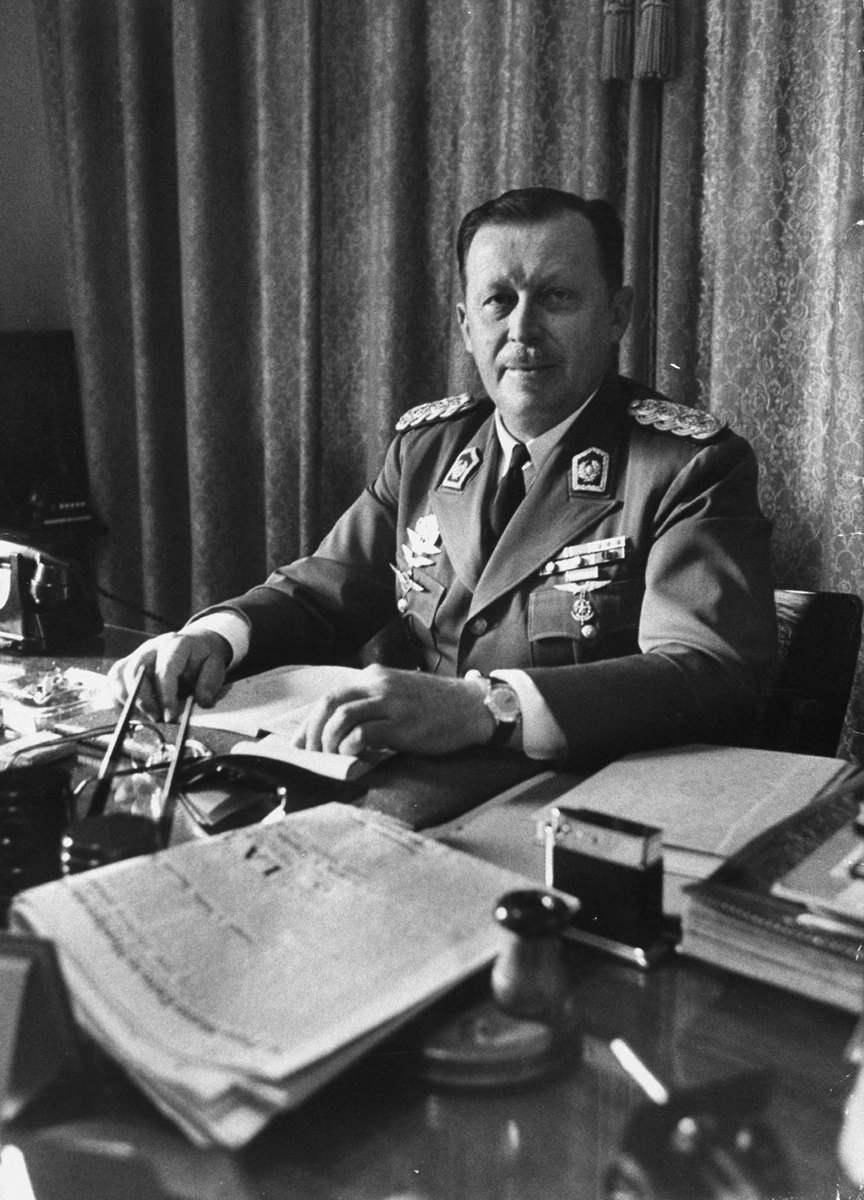
Frank Scherschel · Public domain
Alfredo Stroessner Matiauda was a Paraguayan politician, army general, and military dictator who ruled as the 42nd president of Paraguay from 15 August 1954 until his overthrow in 1989. Known as El Stronato or El Stronismo, his dictatorship was marked by political violence. Before his accession to the presidency, he was the country's de facto leader from May to August 1954. He rose to power after leading the 1954 coup d'état on 4 May, with backing from the Colorado Party and the Paraguayan Army. Following a brief provisional government under Tomás Romero Pereira, he was elected unopposed in the 1954 presidential election, as all opposition parties had been banned since 1947.
- born
- 3 November 1912
- died
- 16 August 2006
- field
- Politics, military
- nationality
- Paraguayan
- known_for
- Dictatorial rule as president of Paraguay from 1954 to 1989
Verified Timeline
Lore & Background
Alfredo Stroessner Matiauda was born in Encarnación on 3 November 1912. His father, Hugo Stroessner, a German Paraguayan, was an accountant from Hof, Bavaria, Germany who immigrated to Paraguay in the last five years of the 1890s. His mother, Heriberta Matiauda, was of Guaraní and Spanish criollo descent. He joined the Paraguayan army at the age of 16. After attending military school in Asunción, Stroessner fought in the Chaco War between Paraguay and Bolivia, and had been promoted to the rank of first lieutenant by the war's end. During the 1947 Paraguayan Civil War, Stroessner supported the Colorado Party, and played an important role in their victory. In 1951, he became commander-in-chief of the army. Stroessner objected to President Federico Chaves's plans to arm the national police and threw him out of office in a coup on 4 May 1954. The National Assembly appointed Tomás Romero Pereira president, who called for special elections to complete Chávez's term. Stroessner became the nominee for the Colorado Party in that year's election on 11 July. He won, as he was the only candidate. He quickly suspended constitutional and civil rights upon taking office on 15 August 1954. With the army and military police, who acted as a secret police, he instituted a period of authoritarian rule and violent political repression. Soon after taking office, Stroessner placed the entire country under a state of siege and suspended civil liberties. The state-of-siege provisions allowed the government to arrest and detain anyone indefinitely without trial, as well as forbid public meetings and demonstrations. It was renewed every 90 days until 1987, except for a brief period in 1959. Although it technically only applied to Asunción after 1970, the courts ruled that anyone charged with security offenses could be brought to the capital and charged under the state-of-siege provisions—even if the offense took place outside the capital. Apart from one 24-hour period on election days, Stroessner ruled under what amounted to martial law for nearly all of his tenure. He was reelected seven times—in 1958, 1963, 1968, 1973, 1978, 1983, and 1988. He appeared alone on the ballot in 1958. In his other elections, he won by implausibly high margins; only once (1968) did he drop below 80 percent of the vote. That campaign was also the only time an opposition candidate got more than 20 percent of the vote. He served for 35 years, with only Fidel Castro having a longer tenure among 20th-century Latin American leaders; though Castro's tenure as president was shorter at 32 years (1976–2008). A devoted anti-communist who brought Paraguay into the World Anti-Communist League, he justified his repression as a necessary measure to protect the country. The use of political repression, threats and death squads was a key factor in Stroessner's longevity as dictator of Paraguay. He maintained virtually unlimited power by giving a free hand to the military and to Minister of Interior Edgar Ynsfrán, who began to harass, terrorize, and occasionally murder family members of the regime's opponents. Stroessner heavily relied on various Colorado Party militias, subordinated to his control, to crush any dissent within the country. During Stroessner's regime, an estimated 3,000 to 4,000 people were murdered, 400 to 500 more 'disappeared', and thousands more imprisoned and tortured. His trusted confidant Lieutenant General Andrés Rodríguez Pedotti seized power in the 1989 coup d'état of 2 and 3 February. Stroessner was exiled to Brazil on 5 February, where he died on 16 August 2006 and was buried.
Reader's Guide
Alfredo Stroessner's significance lies in his 35-year authoritarian rule, which brought political stability to Paraguay after decades of instability but at the cost of severe repression, human rights abuses, and corruption. His regime, known as El Stronato, was characterized by a state of siege that lasted nearly his entire tenure, electoral fraud, and the suppression of opposition through violence and intimidation. Army School of the Americas. The Stroessner regime supported the U.S. invasion of the Dominican Republic and even offered to send troops to Vietnam. However, by the mid-1980s relations cooled, largely because of the international outcry over the regime's excesses, along with its involvement in narcotics trafficking and money-laundering. In 1986, the Reagan administration added his regime to its list of Latin American dictatorships. His legacy continues in Paraguay, where his Colorado Party has retained power and continues to rule through clientelistic practices. The regime's use of death squads, torture, and disappearances left a lasting impact on Paraguayan society, and his rule is remembered as one of the most enduring dictatorships in Latin America.
Did You Know?
- Stroessner served for 35 years, with only Fidel Castro having a longer tenure among 20th-century Latin American leaders; though Castro's tenure as president was shorter at 32 years (1976–2008).
- He placed the entire country under a state of siege soon after taking office, renewed every 90 days until 1987—apart from one 24-hour period on election days, he ruled under what amounted to martial law for nearly all of his tenure.
- During Stroessner's regime, an estimated 3,000 to 4,000 people were murdered, 400 to 500 more 'disappeared', and thousands more imprisoned and tortured.
- Stroessner's Paraguay became a haven for Nazi war criminals, including Josef Mengele, and foreign press often referred to his government as the 'poor man's Nazi regime'.
- He was overthrown on 2 and 3 February 1989 by his trusted confidant Lieutenant General Andrés Rodríguez Pedotti, and exiled to Brazil on 5 February.
Rise to Power
Alfredo Stroessner Matiauda was born in Encarnación on 3 November 1912 to a German Paraguayan father, Hugo Stroessner, an accountant from Hof, Bavaria, who had emigrated in the late 1890s, and a mother of Guaraní and Spanish criollo heritage. He entered the Paraguayan army at sixteen and attended military school in Asunción. He saw combat in the Chaco War against Bolivia, reaching the rank of first lieutenant by the conflict's conclusion. His political alignment crystallized during the 1947 Paraguayan Civil War, when he backed the Colorado Party and played a significant role in their victory. By 1951 he had been elevated to commander-in-chief of the army. The path to the presidency came through a coup on 4 May 1954, launched against President Federico Chaves over the latter's plan to arm the national police. With the backing of the Colorado Party and the military, the coup succeeded. After a brief interim presidency by Tomás Romero Pereira, Stroessner became the Colorado Party's sole candidate for the July 1954 election and won unopposed, taking office on 15 August 1954.
Mechanisms of Authoritarian Control
Upon assuming the presidency, Stroessner swiftly placed the nation under a state of siege, suspending constitutional and civil rights. These provisions permitted the indefinite arrest and detention of individuals without trial and prohibited public gatherings and demonstrations. The state of siege was renewed every ninety days until 1987, with only a brief interruption in 1959. Although nominally restricted to Asunción after 1970, courts interpreted the provisions broadly, allowing anyone charged with security offenses to be hauled to the capital for prosecution under those rules. For nearly his entire thirty-five-year tenure, Stroessner governed under what amounted to martial law, the sole exception being a twenty-four-hour suspension on election days. He maintained power through systematic electoral fraud across seven re-elections from 1958 through 1988, winning by implausibly high margins and never dropping below eighty percent of the vote. The 1967 Constitution permitted his re-election, and 1977 amendments effectively enabled indefinite rule. Repression was carried out through the army, military police acting as a secret police, Colorado Party militias, and the office of Interior Minister Edgar Ynsfrán, who oversaw harassment, terror, and occasional murder of opponents' families.
International Alliances and the U.S. Connection
Stroessner's fervent anti-communism, reflected in Paraguay's membership in the World Anti-Communist League, secured a powerful ally in the United States. The two nations developed close military and economic ties; the Stroessner regime supported the American invasion of the Dominican Republic and even offered to dispatch troops to Vietnam alongside U.S. forces. Between 1962 and 1975, Washington provided $146 million to Paraguay's military government, and nearly four hundred Paraguayan officers received training at the U.S. Army School of the Americas, in the Panama Canal Zone, and on American soil during 1962–1966. The United States played what has been described as a critical supporting role in the country's domestic affairs. This partnership endured until the Carter Administration, which emphasized human rights, though aid continued in Carter's budgets. The Reagan Administration restored warmer relations owing to Stroessner's anti-communist credentials, yet by the mid-1980s the relationship soured amid international condemnation of the regime's abuses, its involvement in narcotics trafficking, and money-laundering. In 1986, the Reagan administration formally listed Stroessner's government among Latin American dictatorships.
Downfall and Enduring Legacy
Stroessner's thirty-five-year grip on power ended abruptly on 2–3 February 1989, when his own trusted confidant, Lieutenant General Andrés Rodríguez Pedotti, led a coup that toppled the dictator. Stroessner was exiled to Brazil on 5 February and spent the remainder of his life in that country, where he died on 16 August 2006 and was buried. His legacy, however, proved remarkably durable. The Colorado Party, the political machine through which Stroessner consolidated and sustained his rule, has retained power in Paraguay well beyond his era, continuing to govern through clientelistic practices that echo the patronage networks of his dictatorship. His nickname, El Stronato, and the political doctrine known as El Stronismo remain part of the country's political vocabulary. The regime's record of political violence, the use of death squads, the indefinite detention of opponents, and the systematic suppression of civil liberties left deep scars on Paraguayan society. The fact that the party he led continues to dominate politics speaks to the institutional structures he built and the clientelistic culture he entrenched over more than three decades of authoritarian rule.
Gallery
More in Political Leaders & Revolutionaries 1-24
Elsewhere in the Political Leaders & Revolutionaries universe
Spotted an error? Know more?
This is a living reference — every entry is fact-audited, and reader corrections feed straight into our audit queue. Suggest an edit · See this site's audit record