
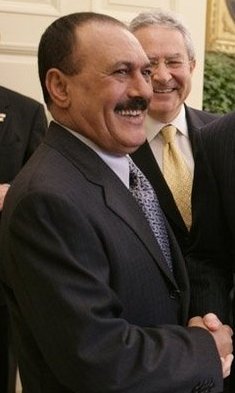
Ali Abdullah Saleh
First president of unified Yemen; resigned in 2012; killed by Houthi sniper in 2017.

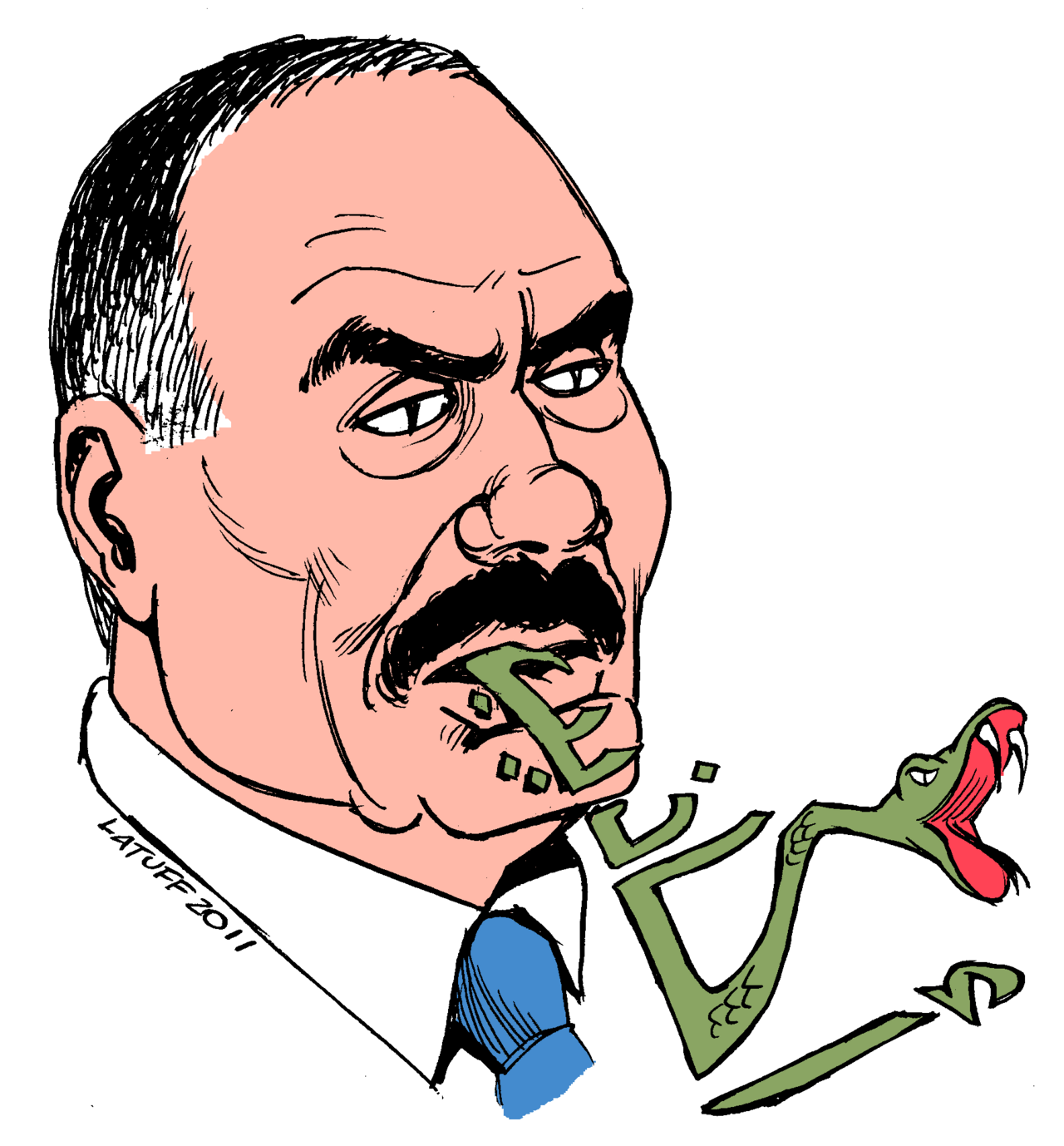
Carlos Latuff · Public domain
Ali Abdullah Saleh (21 March 1947 – 4 December 2017) was a Yemeni military officer and politician who served as the first president of the Republic of Yemen from the Yemeni unification in 1990 until his resignation in 2012, following the Yemeni revolution. Previously, he had served as the fifth and last President of the Yemen Arab Republic (North Yemen), from July 1978 to 22 May 1990, after the assassination of President Ahmad al-Ghashmi. A veteran and officer of the North Yemen civil war, Saleh consolidated power and restored civilian rule after al-Ghashmi's assassination in 1978. Despite military defeat against South Yemen in the Second Yemenite War, a rebellion, and multiple coup attempts, Saleh managed to bring stability to North Yemen by the mid 1980's, and enjoyed support from both the United States and the Soviet Union.
- born
- 21 March 1947
- died
- 4 December 2017
- field
- Military officer, politician
- nationality
- Yemeni
- known_for
- First president of unified Yemen; autocratic rule; alliance with Houthis; killed
Verified Timeline
Lore & Background
Ali Abdullah Saleh Affash was born on 21 March 1947 to a poor Zaydi family in Beit al-Ahmar village from the Sanhan clan, whose territories lie some 20 kilometers southeast of Sanaa. Saleh's father, Abdallah Saleh, died after he divorced Ali Abdullah's mother when Saleh was still young. His mother later remarried her deceased former husband's brother, Muhammad Saleh, who soon became Saleh's mentor and stepfather. Saleh received his primary education at Ma'alama village before leaving to join the Royal (North Yemeni) Armed Forces in 1958 as an infantry soldier and was admitted to the Royal Military Academy in 1960. In 1963, he was commissioned as a second lieutenant in armoured corps. Though not a Nasserist himself, he participated in the Nasserist-inspired military coup of 1962, which was instrumental in the removal of King Muhammad al-Badr and the establishment of the Yemen Arab Republic. During the North Yemen Civil War, he attained the rank of major by 1969. He received further training as a staff officer in the Higher Command and staff C Course in Iraq, between 1970 and 1971, and was promoted to lieutenant colonel. He became a full colonel in 1976 and was given command of a mechanised brigade. In 1977, President Ahmad al-Ghashmi appointed him as military governor of Taiz. After al-Ghashmi was assassinated on 24 June 1978, Colonel Saleh was appointed to be a member of the four-man provisional presidency council and deputy to the general staff commander. On 17 July 1978, Saleh was elected by the parliament to be the president of the Yemen Arab Republic, while simultaneously holding the positions of chief of staff and commander-in-chief of the armed forces. On 10 August 1978, Saleh ordered the execution of 30 officers who were charged with being part of a conspiracy against his rule. Saleh was promoted to major general in 1980, elected as the secretary-general of the General People's Congress party on 30 August 1982, and re-elected president of the Yemen Arab Republic in 1983. After South Yemen had become unstable following the 1986 crisis and the fall of communism, Saleh achieved reunification as President of the new Republic of Yemen, sharing power in tandem with South Yemen's last leader and transitional Vice President Ali Salem al-Beidh, prominent general Mohsen al-Ahmar and tribal Sheikh and leader of the Islamist Islah movement, Abdullah al-Ahmar, through a Presidential Council. Due to apparent North–South divisions, al-Beidh left the Council in 1993, and in the brief civil war that followed, Saleh's forces, assisted by jihadists such as the Egyptian Islamic Jihad, roundly defeated Southern forces in July 1994. From 1994 onward, Saleh returned to autocratic rule through rule by decree, and was confirmed by elections in 1999, 2006, and a controversial constitutional referendum in 2001. Until 2011, he presided over stable economic growth and an insurgency by the Ansar Allah movement, commonly known as the Houthis. In 2011, in the wake of the Arab Spring, Saleh's time in office became increasingly precarious, until he was eventually ousted as president in 2012. He was succeeded by Abdrabbuh Mansur Hadi, who had been serving as vice president since 1994, and acting president since 2011. Himself a Zaydi Shia Muslim, Saleh openly allied with the Houthis in May 2015 during the Yemeni civil war. In December 2017, he declared his withdrawal from his coalition with the Houthis and instead sided with his former enemies – Saudi Arabia, the United Arab Emirates and President al-Hadi. On 4 December 2017, during a battle between Houthi and Saleh supporters in Sanaa, the Houthis accused Saleh of treason, and he was killed by a Houthi sniper. Reports were that Saleh was killed while trying to flee his compound in a car; however, this was denied by his party officials, who said he was killed at his house.
Reader's Guide
Ali Abdullah Saleh's significance lies in his long, transformative, and ultimately violent role in modern Yemeni history. His rule was marked by autocratic consolidation, a patronage system centered on his family and allied tribes, and a pragmatic foreign policy that shifted from opposing the Gulf War to deepening ties with the West during the war on terror. Evidence emerged that Islamic terrorism may have been used and encouraged by Saleh in order to win Western support and for disruptive politically motivated attacks. His legacy is contested: he brought stability to North Yemen by the mid 1980's and oversaw stable economic growth until 2011, but also presided over significant poverty and an insurgency by the Houthis. His final alliance with the Houthis in May 2015 and subsequent break with them in December 2017 led to his death, underscoring the volatility of Yemeni politics and the personalist nature of his rule.
Did You Know?
- Saleh was born on 21 March 1947 to a poor Zaydi family in Beit al-Ahmar village from the Sanhan clan, some 20 kilometers southeast of Sanaa.
- He joined the Royal (North Yemeni) Armed Forces in 1958 as an infantry soldier and was admitted to the Royal Military Academy in 1960.
- On 10 August 1978, Saleh ordered the execution of 30 officers charged with being part of a conspiracy against his rule.
- Saleh was promoted to field marshal on 24 December 1997, making him the highest-ranking military officer in Yemen.
- He was killed by a Houthi sniper on 4 December 2017 during a battle in Sanaa; reports that he was killed while fleeing in a car were denied by his party officials.
From Infantryman to Head of State
Saleh entered the Royal North Yemeni Armed Forces in 1958 as a young infantryman from a destitute Zaydi family in a small village near Sanaa. Three years later he was admitted to the Royal Military Academy, and by 1963 he had been commissioned as a second lieutenant in the armoured corps. Though he was not personally a Nasserist, he took part in the 1962 military coup that toppled King Muhammad al-Badr and established the Yemen Arab Republic. The subsequent civil war accelerated his advancement; by 1969 he held the rank of major. Staff-officer training in Iraq during 1970–71 brought him to lieutenant colonel, and by 1976 he commanded a mechanised brigade as a full colonel. President Ahmad al-Ghashmi appointed him military governor of Taiz in 1977. When al-Ghashmi was assassinated in June 1978, Saleh was placed on a four-man provisional presidency council. Just three weeks later, parliament elected him president of North Yemen, a post he held simultaneously with the roles of chief of staff and commander-in-chief. Observers noted that he rose not through tribal prestige but through his own initiative, building a patronage network with his seven brothers and extended kin in key positions.
Unification and the 1994 Civil War
After surviving the Second Yemenite War against South Yemen, a domestic rebellion, and several coup attempts, Saleh had nonetheless managed to restore a degree of stability in North Yemen by the mid-1980s, earning the backing of both Washington and Moscow. The political landscape shifted dramatically after the 1986 crisis in the south and the collapse of communism, which left South Yemen in disarray. Seizing the moment, Saleh achieved the long-sought reunification of the two Yemeni states in 1990, becoming the first president of the new Republic of Yemen. Power was initially shared through a Presidential Council that included South Yemen's last leader Ali Salem al-Beidh, prominent general Mohsen al-Ahmar, and tribal and Islamist leader Abdullah al-Ahmar. Tensions along North-South lines proved irreconcilable: al-Beidh departed the Council in 1993, and a short civil war erupted the following year. Saleh's forces, reportedly bolstered by fighters from the Egyptian Islamic Jihad, delivered a decisive defeat to Southern armies in July 1994. From that point forward, he abandoned the collegial arrangement and governed by decree, a style of autocratic rule that would define the rest of his tenure.
Shifting Alliances and the War on Terror
As the newly unified Yemen's president, Saleh initially alienated both the United States and Saudi Arabia by voicing opposition to the 1991 Gulf War, a stance that contributed to the departure of more than 800,000 Yemeni workers from Saudi territory. Once he had consolidated absolute authority after the 1994 civil war, however, his foreign policy pivoted sharply. During the post-9/11 war on terror, he cultivated considerably deeper ties with Western powers, particularly Washington. Yet this rapprochement was not without controversy: evidence later surfaced suggesting that Saleh may have exploited, and in some cases encouraged, Islamic terrorist activity both to court Western support and to carry out politically motivated disruptions at home. Domestically, his rule from 1994 onward was marked by confirmed elections in 1999 and 2006 and a contentious constitutional referendum in 2001, alongside a period of relatively stable economic growth. That stability coexisted with a growing insurgency led by the Ansar Allah movement, commonly known as the Houthis, which would ultimately become the defining security challenge of his later presidency.
Ouster, Final Betrayal, and Death
The Arab Spring protests that swept across North Africa and the Middle East in 2011 reached Yemen and made Saleh's grip on power increasingly untenable. By 2012 he was forced to resign, handing the presidency to Abdrabbuh Mansur Hadi, who had served as vice president since 1994 and as acting president since 2011. Saleh's political life did not end there. In May 2015, as the Yemeni civil war intensified, the Zaydi Shia leader openly threw his support behind the Houthi movement, whose forces and allied insurgents succeeded in capturing the capital, Sanaa, prompting Hadi to resign and flee the country. Yet by December 2017, Saleh had reversed course again, publicly withdrawing from his Houthi coalition and aligning himself with his former adversaries: Saudi Arabia, the United Arab Emirates, and President Hadi. The alliance collapsed within days. On 4 December 2017, amid fighting between Houthi and Saleh-loyalist forces in Sanaa, the Houthis branded him a traitor. A Houthi sniper killed him; his party officials insisted he was shot at his residence, while other reports claimed he was struck while attempting to escape his compound by car.
Gallery

More in Political Leaders & Revolutionaries 1-24
Elsewhere in the Political Leaders & Revolutionaries universe
Spotted an error? Know more?
This is a living reference — every entry is fact-audited, and reader corrections feed straight into our audit queue. Suggest an edit · See this site's audit record